
Know where the signal is.
Not just that it exists.
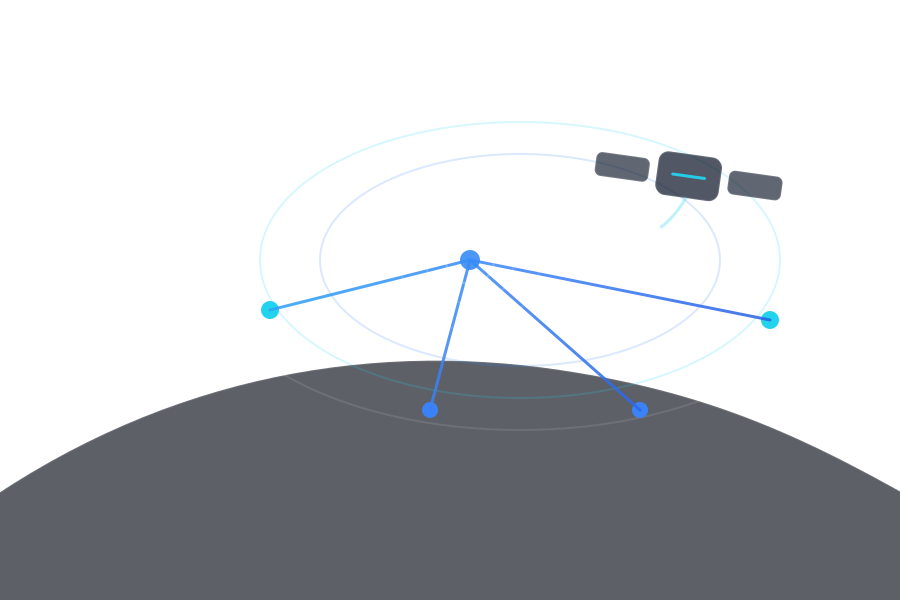
Radio-Mapper is a deployable RF triangulation network using SDR “buoy” nodes and evidence-first processing to locate transmitters in defined areas—fast.
Dense sensor economics
Low cost per node enables resilient coverage and better geometry—deploy more sensors where it matters.
Evidence-first localization
Quality metrics, audit trails, and confidence gating—built for operators who need defensible results.
API + operator UI
Real-time map view for situational awareness plus APIs for alerting, reporting, and integrations.
Built for real-world RF problems
Start with a bounded region. Get time-to-location down. Expand once it’s operational.
Defense & EW support
Localize emitters of interest and interference sources around sites, ranges, and exercises.
Public safety & SAR
Accelerate time-to-location for distress beacons and operational radios in incidents and training.
Critical infrastructure
Persistent monitoring and rapid localization of interference near airports, ports, utilities, and industrial sites.
Supported today, and what’s on the roadmap
Unlike space-based providers, we’re optimized for persistent coverage of a defined area using ground sensors. This table sets expectations clearly—no hand-waving.
| Band | Typical range | Best-fit use | Output | Status |
|---|---|---|---|---|
| VHF/UHF | ~30–1000 MHz (deployment-specific) | FM calibration, land mobile radio (LMR), interference hunting in defined areas | Detections + map visualization + API outputs | Active |
| Higher bands | Depends on sensor hardware | Site-specific monitoring (hardware-dependent) and expanded signal types | Deployment-scoped | Roadmap |
Deploy → detect → correlate → locate
1) Deploy nodes
Place low-cost SDR receivers (“buoys”) around your area of interest with reliable timing and backhaul.
2) Detect + correlate
Nodes detect configured RF activity and stream timestamped detections (and optional IQ/features).
3) Locate + act
The central processor estimates locations (e.g., IQ‑TDOA) and publishes results only when quality gates pass.
Start small. Scale by node count.
Pilot kits validate your environment; site deployments deliver persistence; enterprise adds fleet ops and integrations.
Pilot Kit
3–5 nodes, baseline dashboards, initial calibration + training.
Best for: proof-of-value, demos, labs.
Site Deployment
10–20 nodes, persistent monitoring, alerting workflows, evidence packs.
Best for: airports, ports, utilities, cities.
Enterprise
Multi-site fleet ops, SSO options, APIs + integrations, support SLAs.
Best for: multi-region programs.
Security and “own your data” by design
Run on-prem, control retention, and keep operators in the loop with transparent quality signals.
Access control
Authenticated dashboard and protected APIs for authorized personnel.
Auditability
Evidence and quality gates help you distinguish “possible” from “publishable”.